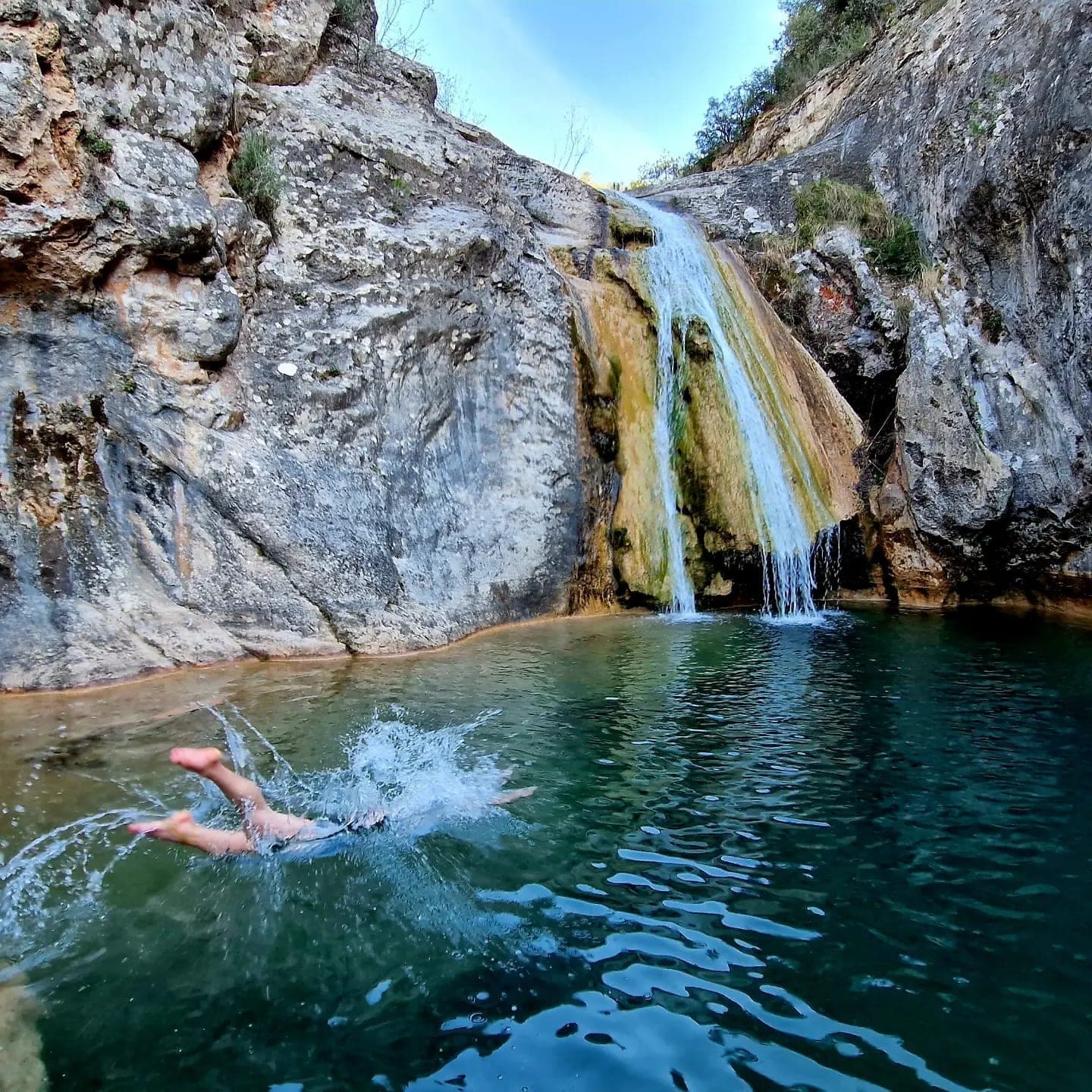
Gorgs del Febró
Waterfalls and swimming holes in the Prades mountains — amazing in the summer, Kai’s own words, and exactly when the Montsant itself runs dry.
Ask us for the best access point before you go.
What to do
A string of natural pools and small waterfalls in the Prades mountains, cut by a tributary of the Siurana river. They have names — El Gorg is the big one, with El Gorguet and La Gorguina above and below it — and the main pool is the one people picture: a wide blue-green basin taking the fall at one end, deep enough to swim properly rather than stand about in. La Febró itself, the village these are named for, has a population of around forty and is one of the least inhabited municipalities in Catalonia. That is the useful context. This is not a managed attraction with a car park and a kiosk; it is a river in a very quiet corner of the mountains that happens to do something spectacular for part of the year. Kai’s own verdict is that the Gorgs are amazing in the summer, and that timing is the whole point of the place. It is the direct answer to the Montsant’s one honest weakness: exactly when the massif goes dry and hot and the water disappears from the tops, the Gorgs are running well. Treat the two as a matched pair and plan the hot months around this one. The reverse is also true. Out of season, and after a dry spell, the pools can be low and much less impressive than the photographs suggest. Nobody should drive out in March expecting the August version. Getting to them means walking, not driving up. Depending on which approach you take it is roughly an hour on foot, with common starts from Arbolí, from La Febró, and from up at La Mussara. Which of those is the right one varies with the water level and the season, and it is not the same answer every year — so ask at the house before you set off, instead of trusting an old map or a stale online route. Asking is the single most useful thing you can do before setting off, and it is the reason a guest who asks has a better day than one who does not. The walk in is part of the appeal rather than a toll on it. The paths run through pine and holm oak with the stream below, and because the pools are strung along the water you pass several smaller ones before reaching the main basin. Plenty of people stop at the first good pool and never see the others, which is a perfectly reasonable way to spend the day. It is cold. These are mountain pools fed by a stream, never warmed by the sun, and the first thirty seconds are unpleasant even in August — which, if you have spent the week going between a hot sauna and a cold pool at the house, will feel entirely familiar. Canyoning is a thing here for anyone who wants the more committed version, working down through the sequence of falls rather than walking to one pool and swimming in it. That is a guided activity and needs booking with an operator; it is not something to improvise. There is no entry fee and nothing to book for the walk-and-swim version. Take shoes you can walk in and do not mind getting wet, take your litter home, and go early on an August weekend if you would rather have a pool to yourself. It is a small place in a very quiet municipality, and it is at its best when there are four people there, not forty. It combines well with the rest of that corner of the Prades. One of the usual approaches starts up at La Mussara, so a swim and the abandoned village can be the same outing, which makes for one of the better days available from the house: climb, ruin, view, swim, and back down for the sauna in the evening. That sequence is about as good an argument for this particular corner of Catalonia as any.